Scheduled Isn’t Completed: The Maintenance Numbers Production Managers Need
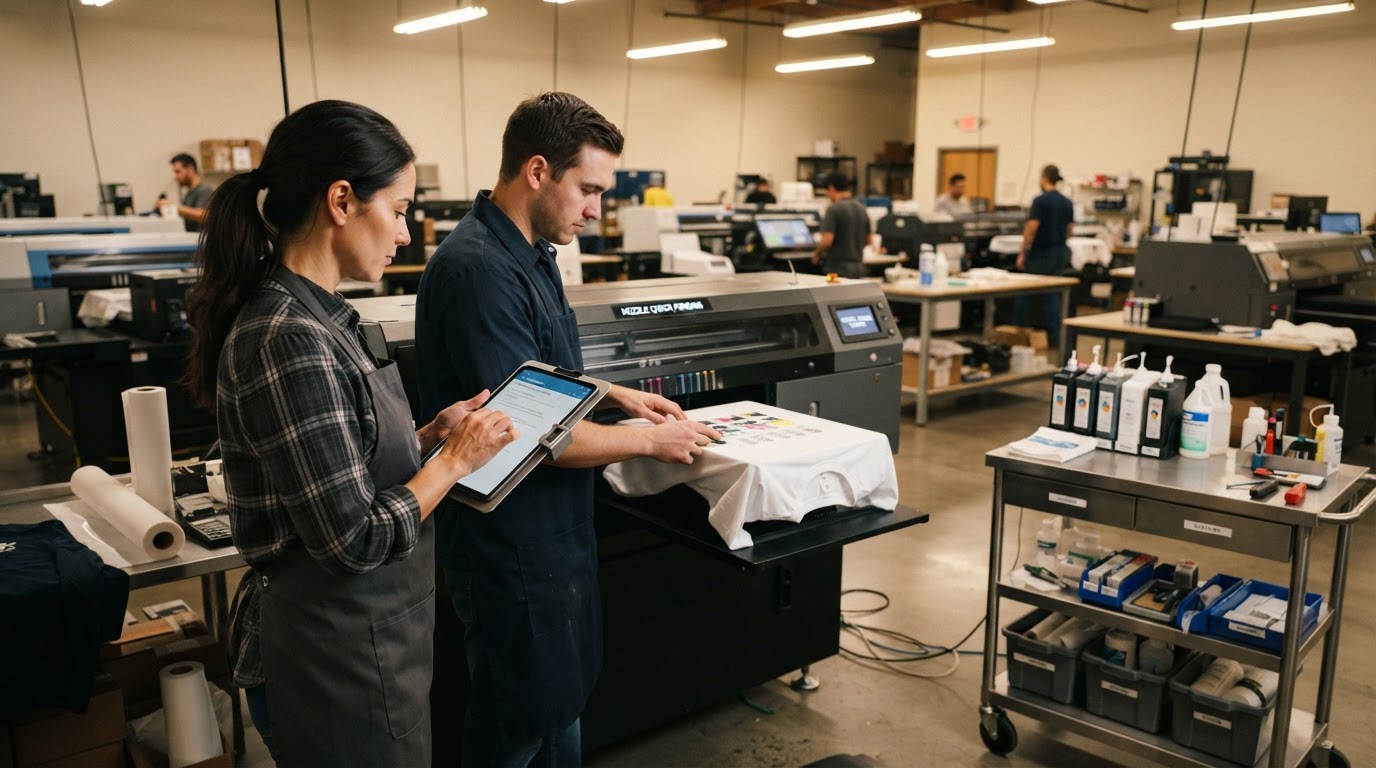
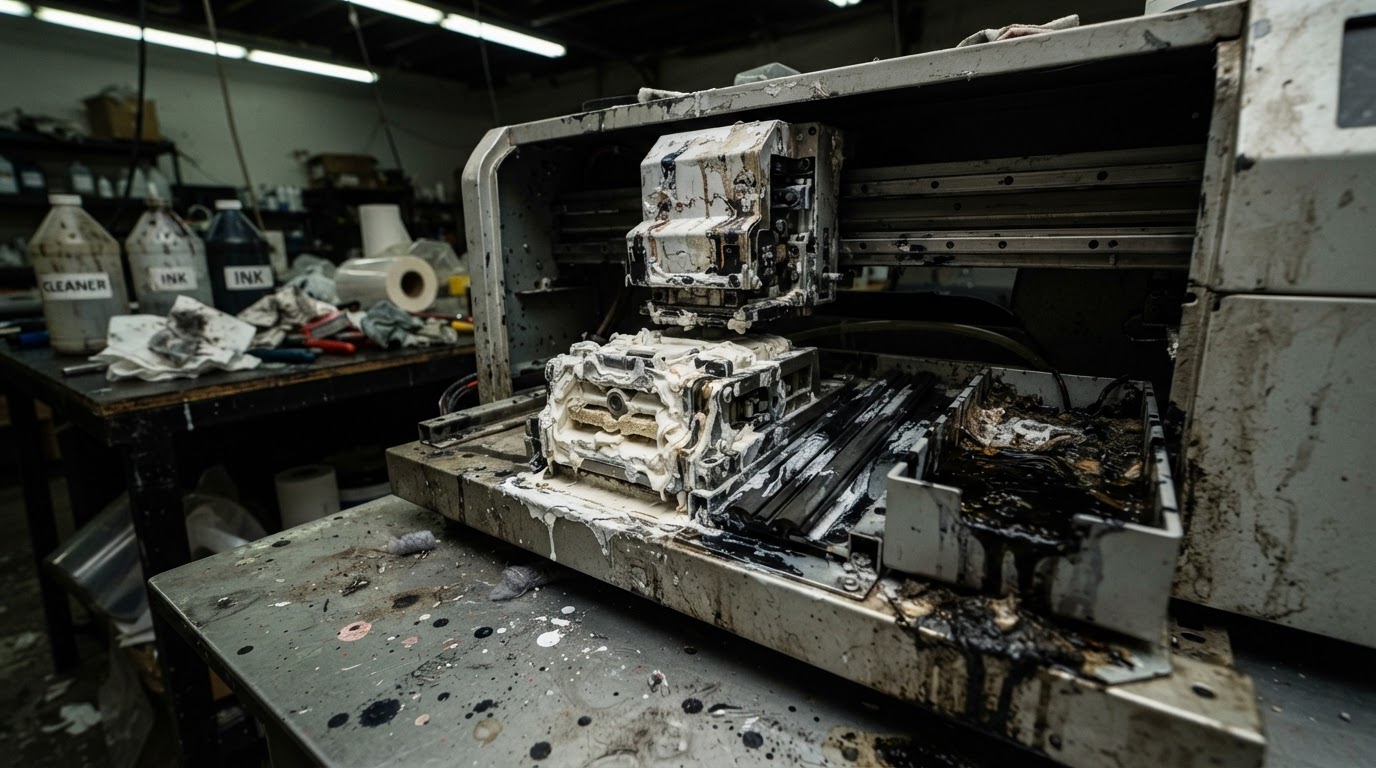
What does the next shift know about the equipment concern your current operator just noticed? In DTG and DTF production, a changing nozzle-check pattern or recurring print defect needs a clear record: what was observed, which manufacturer-approved action was taken, and what happened afterward. A maintenance schedule records what should happen. Useful documentation helps the next person understand what actually happened.
When print supervisors and department managers evaluate equipment health, they frequently encounter a gap between scheduled tasks and completed actions. A printer manufacturer may specify daily white-ink agitations, cap-seal cleanings, and environmental logging, but without clear operational metrics, management cannot easily see whether those routines are occurring consistently or where bottlenecks are forming.
A maintenance calendar shows what should happen under ideal conditions. Practical management logs reveal what actually happened across real shifts, competing job priorities, and operator handoffs.
Empirical evidence: research on scheduled maintenance and execution gaps
To ground this discussion in empirical data, examine findings from the 2026 Limble State of Maintenance report. This vendor-published survey gathered self-reported responses from 686 U.S. maintenance and operations professionals surveyed between July 29 and August 6, 2026. The survey spans broad industrial sectors—including manufacturing, facilities, and distribution—and represents reported estimates across diverse facility types rather than apparel-decoration specific benchmarks.
Key findings from the report highlight the difference between operational plans and daily execution:
- Scheduled PM completion rate: Surveyed leaders estimated that their teams complete just 54% of scheduled preventive maintenance tasks.
- Single-point knowledge vulnerability: 74% of maintenance organizations reported having at least one critical asset that exactly one employee knew how to repair.
- Software ownership vs. team adoption: While 82% of respondents reported that their organization owns and operates a computerized maintenance management system (CMMS), only 39% reported consistent use across their entire team.
It is essential to interpret these numbers with precision. The difference between 82% software ownership and 39% consistent team adoption reflects a gap between system deployment and daily operational habits—it is not a calculated failure rate, nor should managers assume every respondent answered both questions with identical criteria. Furthermore, cross-industry survey data does not prove that software adoption automatically prevents hardware failure in a DTF or DTG print room. What it demonstrates is that tool availability and consistent execution are distinct management challenges.
Evidence summary: cross-industry maintenance execution research
| Finding | Source / year | Scope | Management relevance |
|---|---|---|---|
| Leaders estimated completion of just 54% of scheduled preventive maintenance. | Limble State of Maintenance | 686 U.S. maintenance & ops professionals; vendor publisher: Limble (2026) | Highlighting a substantial gap between planned maintenance routines and real-world execution. |
| 74% reported at least one critical asset that only one employee knew how to repair. | Limble State of Maintenance | Cross-industry operational survey; reported organizational estimates (2026) | Single-person technical knowledge creates severe downtime risk during staffing changes or shift transitions. |
| 82% report CMMS ownership, but only 39% report consistent team-wide utilization. | Limble State of Maintenance | Same survey sample; comparative utilization metrics across facilities (2026) | System ownership does not guarantee operational adoption; managers must measure daily compliance. |
Cross-industry research findings from Limble (2026). Sample size of 686 reflects total survey respondents across manufacturing and operations sectors; specific questions may have subsets of respondents. Data reflects self-reported operational estimates.
Five practical maintenance & handoff measures for print supervisors
Rather than relying on informal verbal check-ins or unmonitored checklists, production managers can implement five structured operational metrics. These measures provide objective visibility into shop maintenance health and shift communication:
- 1. On-time maintenance completion percentage — Calculated as (Tasks completed by their due time ÷ Tasks due in the period) × 100. Record tasks completed late as a separate category, as delayed maintenance on white-ink systems carries different risks than task omission.
- 2. Shift handoff completeness percentage — Calculated as (Shift handoffs containing every required log field ÷ Total handoffs reviewed) × 100. Define explicit required fields—such as nozzle check status, room humidity, and open concerns—before scoring.
- 3. Time to acknowledge an equipment concern — The elapsed minutes between an operator recording an unusual symptom and formal acknowledgement by a supervisor or lead technician. Keep this response metric separate from diagnostic time, repair duration, or return-to-service validation.
- 4. Unresolved concerns at shift change — A simple count of open machine observations at shift transition, categorized by severity level and age (e.g., open for >1 shift).
- 5. Repeat issue frequency — Tracking recurring observations (such as white channel dropouts or capping station seal leaks) logged for the same machine within a 14-day window. Note that issue repetition identifies a trend requiring attention, but does not by itself establish root cause.
Practical numerical example: evaluating completion metrics
To understand why tracking on-time completion separately from eventual completion matters, consider this clearly labeled hypothetical example. The figures are illustrative operational assumptions for demonstration purposes, not measured customer data:
Suppose a print room schedules 20 preventive maintenance tasks across a daily shift window (including white ink agitations, capping station wipes, environmental logs, and waste bottle checks). At shift end, logs show:
- 15 tasks were completed on time before active production runs began.
- 3 tasks were completed late (after production commenced or during mid-shift pauses).
- 2 tasks remain open and unexecuted at shift change.
Applying our metrics yields two distinct figures:
- On-time completion rate: (15 ÷ 20) × 100 = 75%
- Eventual completion rate: ((15 + 3) ÷ 20) × 100 = 90%
These percentages answer different management questions. Eventual completion shows how much scheduled work was ultimately completed. On-time completion shows whether it happened within the required window. In this hypothetical example, 25% of tasks were late or still open. That calls for reviewing the affected tasks, their requirements, and the reasons for delay; the percentage alone does not establish equipment damage or predict a failure.
Structuring an effective shift handoff record
When an operator completes a shift, verbal notes often get lost in the noise of a busy shop floor. A standardized handoff record ensures critical operational context transfers reliably. An effective handoff record should contain seven core items:
- 1. Machine identification — Specific printer engine, dryer, or shaker unit ID.
- 2. Date, time, and outgoing operator name.
- 3. Observed symptom — Clear description of any physical or print anomaly (e.g., slight deflection on channel 3 white nozzle print).
- 4. Inspection image or test print — Attached photograph of nozzle pass pattern or component condition, where appropriate.
- 5. Approved action taken — Documented cleaning or adjustment performed in accordance with manufacturer guidelines.
- 6. Result after action — Outcome of the follow-up verification print or test.
- 7. Open concern & assigned owner — Clear designation of unresolved issues, the assigned lead, and the scheduled re-check time.
Operational observations vs. technical diagnosis
A vital aspect of shop floor management is training operators to log clear physical observations without making premature technical assumptions. For instance:
- Missing nozzles or pattern gaps should be logged as 'nozzle test pattern void in white channel 2,' requiring inspection—not automatically diagnosed as a blown printhead.
- Ink build-up on wiper blades should be recorded as 'pigment accumulation on wiper edge,' prompting cleaning per manual guidelines—not assumed to be a pump assembly failure.
- Dried ink around the capping station rim should be documented as 'capping seal crusting,' requiring routine maintenance rather than immediate component replacement.
All inspection, cleaning, and recovery procedures should strictly follow the equipment manufacturer's approved standard operating procedures. Documenting observations accurately allows lead technicians and service providers to conduct systematic troubleshooting when required.
Addressing operational constraints
When maintenance tasks are skipped or delayed, managers must look beyond operator compliance to examine underlying operational constraints. Common real-world barriers include:
- Workload & schedule pressure — High job volume competing directly with scheduled maintenance windows.
- Staffing & coverage gaps — Lack of designated coverage during breaks or shift overlaps.
- Physical access & room environment — Restricted workspace around machines or unmonitored ambient humidity shifts.
- Training & procedural clarity — Operators uncertain of exact cleaning methods or inspection criteria.
- Part & supply availability — Missing cleaning swabs, approved solvent, or fresh wiper blades.
Resolving these systemic constraints is a primary managerial responsibility. Providing operators with clear standard procedures and dedicated time ensures routines can be completed safely and consistently.
Supporting daily maintenance discipline
Building consistent maintenance habits requires tools tailored to daily operator workflows. Earlier field notes explore how daily maintenance routines impact long-term equipment value and shop profitability:
WhiteGuard™ LITE is a free, single-user web utility designed to assist individual operators in structuring daily maintenance routines. It provides a simple four-step check (agitation, nozzle check verification, capping inspection, and environment log) alongside reference operating guides stored directly on the local device. It is important to note that WhiteGuard™ LITE is an individual operator tool—it is not a multi-user management dashboard, fleet management system, predictive maintenance platform, or CMMS replacement, nor does it guarantee equipment protection or warranty coverage. It simply provides a clean, device-local structure for daily operator care.
Build your daily operator routine
Explore WhiteGuard™ LITE to structure daily white-ink checks and keep reference operating procedures accessible on your device.
Get buyer-first guidance in your inbox
New field notes on DTF, DTG & UV ownership — no hype, no rankings.